This post is also written in the following language:
 日本語 (Japanese)
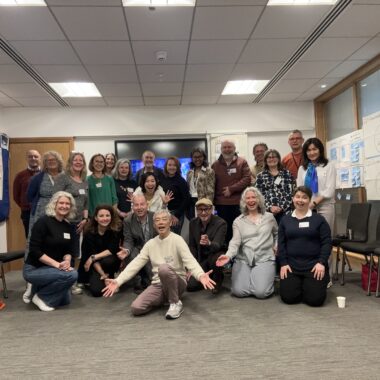
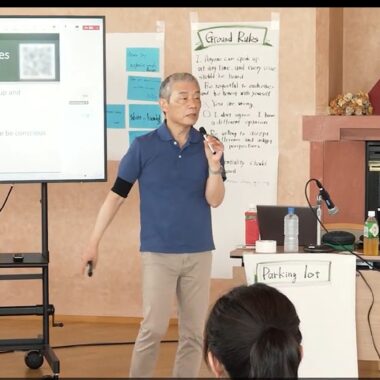
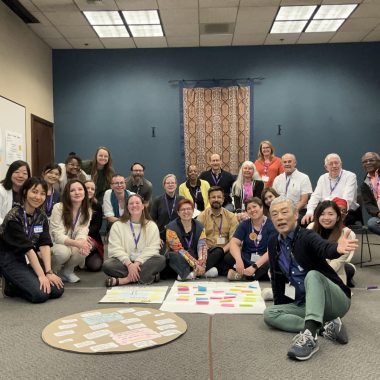
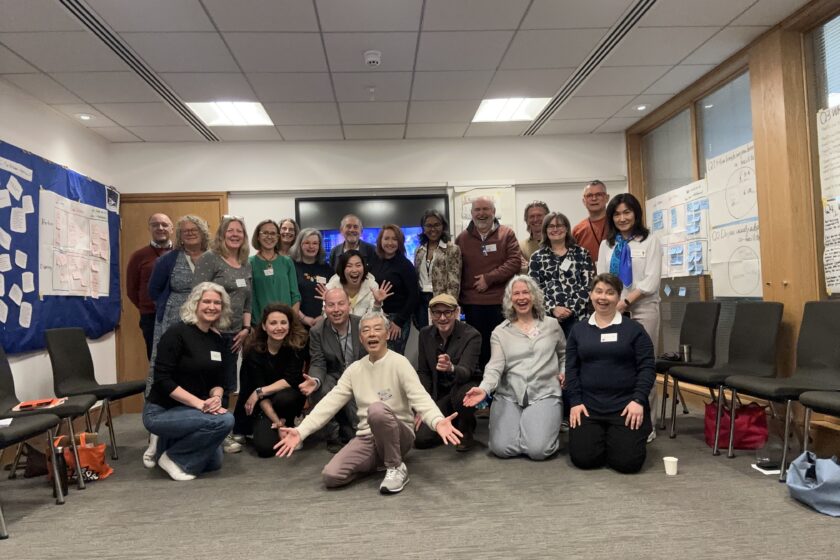
This is a report by Hideyuki Yoshioka, CEO of Knowledge Sign, on facilitating a workshop at the IAF (The International Association of Facilitators) international conference held in Birmingham, UK, in April 2025, associating with two other Japanese facilitators.
The IAF is an international organization of facilitators with thousands of members worldwide, hosting showcase conferences annually in regions such as Asia, America, Europe, and Africa.
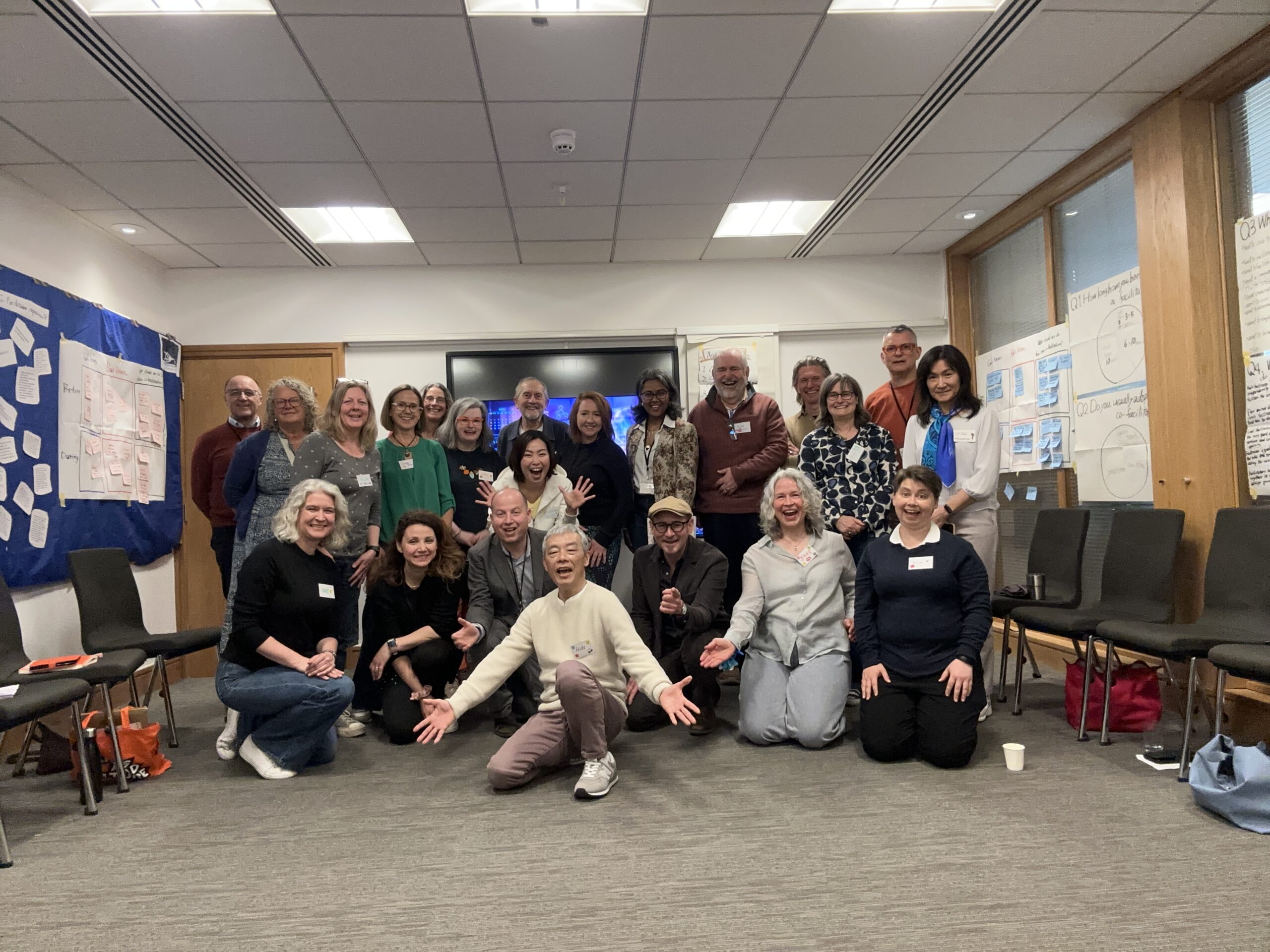
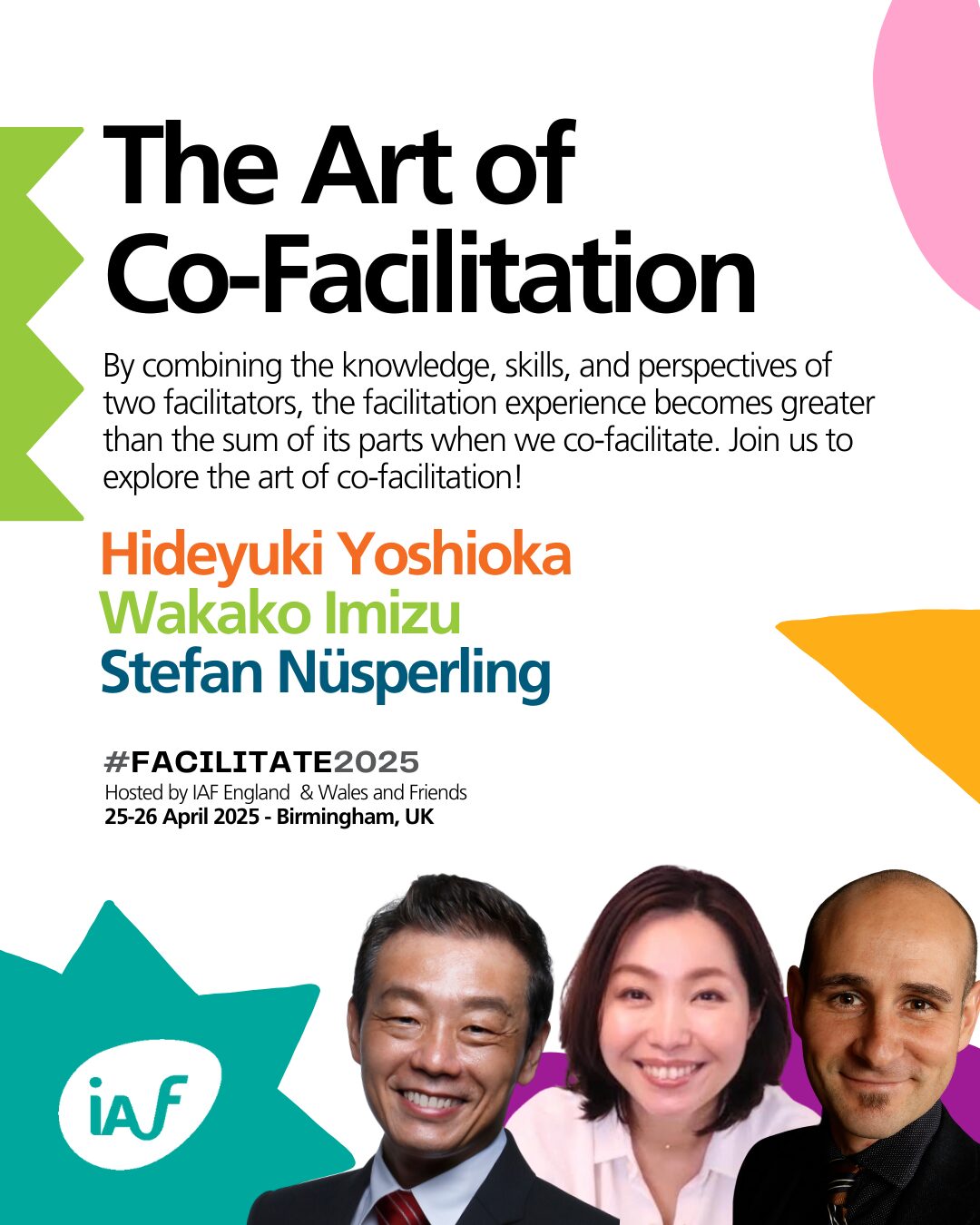
The conference I attended was organized by the England & Wales branch, targeting Europe. Together with career consultant Wakako Imizu and Stefan Nüsperling, CEO of Nüworks, the three of us facilitated a one-hour session titled “The Art of Co-Facilitation.”
Co-facilitation refers to two or more facilitators working together to facilitate a session. This is common in practice, and especially at conference workshops, most sessions are conducted in a co-facilitation style.
Co-facilitation offers benefits to both facilitators and participants. This workshop was designed to explore how to maximize these benefits for both facilitators and participants.
In designing the workshop, we began by researching how facilitators approach co-facilitation. We conducted a survey with facilitators both in Japan and abroad, asking the following questions:
1. Years of facilitation experience
2. How often do you co-facilitate?
3. When do you think co-facilitation is necessary?
4. What style of co-facilitation do you prefer?
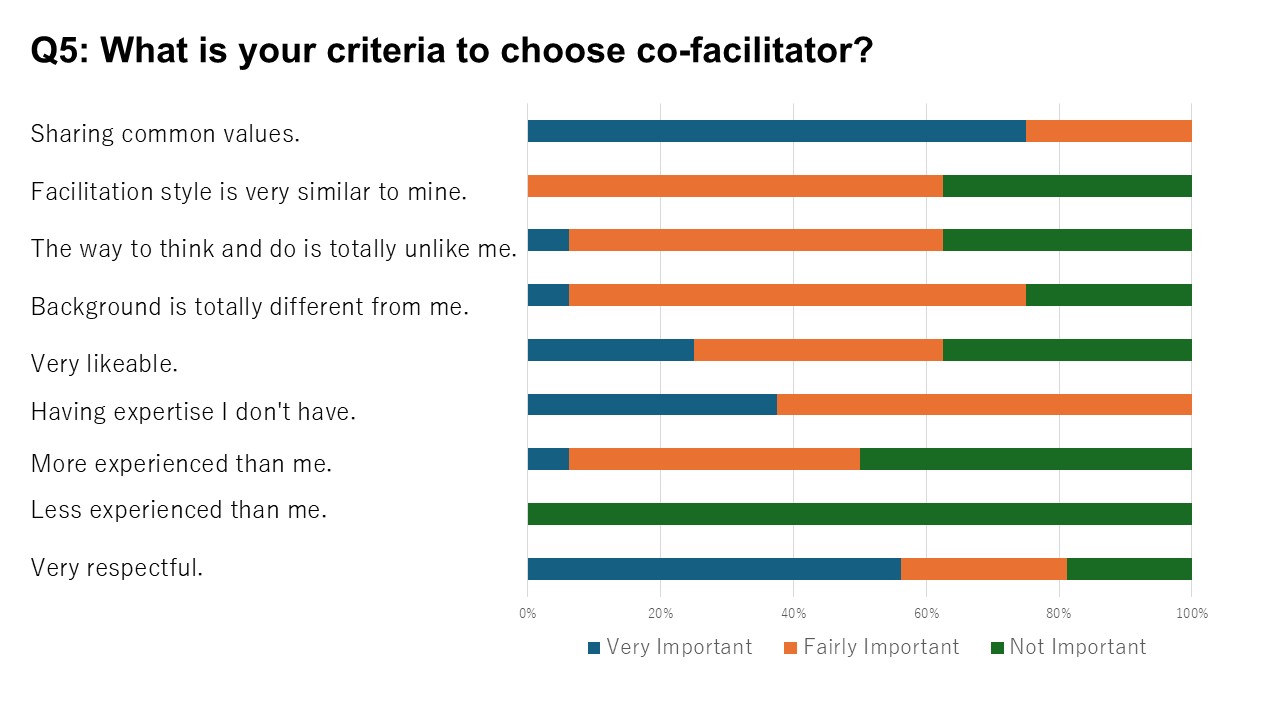
5. What criteria do you use to select a co-facilitator?
6. What was your best co-facilitation experience?
7. What was your worst co-facilitation experience?
8. What do you think is the value of co-facilitation for facilitators?
9. What do you think is the value of co-facilitation for participants?
10. What should facilitators do before the session to maximize value for both facilitators and participants?
11. What should facilitators do during the session to maximize value for both facilitators and participants?
12. What should facilitators do after the session to maximize value for both facilitators and participants?
The detailed results of this survey are published at the following URL: https://miro.com/app/board/uXjVJ_jzqeU=/?moveToWidget=3458764656817846172&cot=10
Of course, there is no single correct answer regarding co-facilitation, and there could be various perspectives. For example, the criteria for selecting a co-facilitator also varies as below.
Based on these results, our workshop aimed to:
• Quickly share the insights we had learned prior to the session.
• Draw out new ideas and approaches to co-facilitation from participants.
• Allow participants to enjoy themselves while observing a co-facilitation role-play.
To achieve these goals, we displayed a lot of flip charts that show the result of the survey and we adopted an approach called “Theatrical Facilitation.” In this method, facilitators play certain roles and conduct the session in a theatrical format.
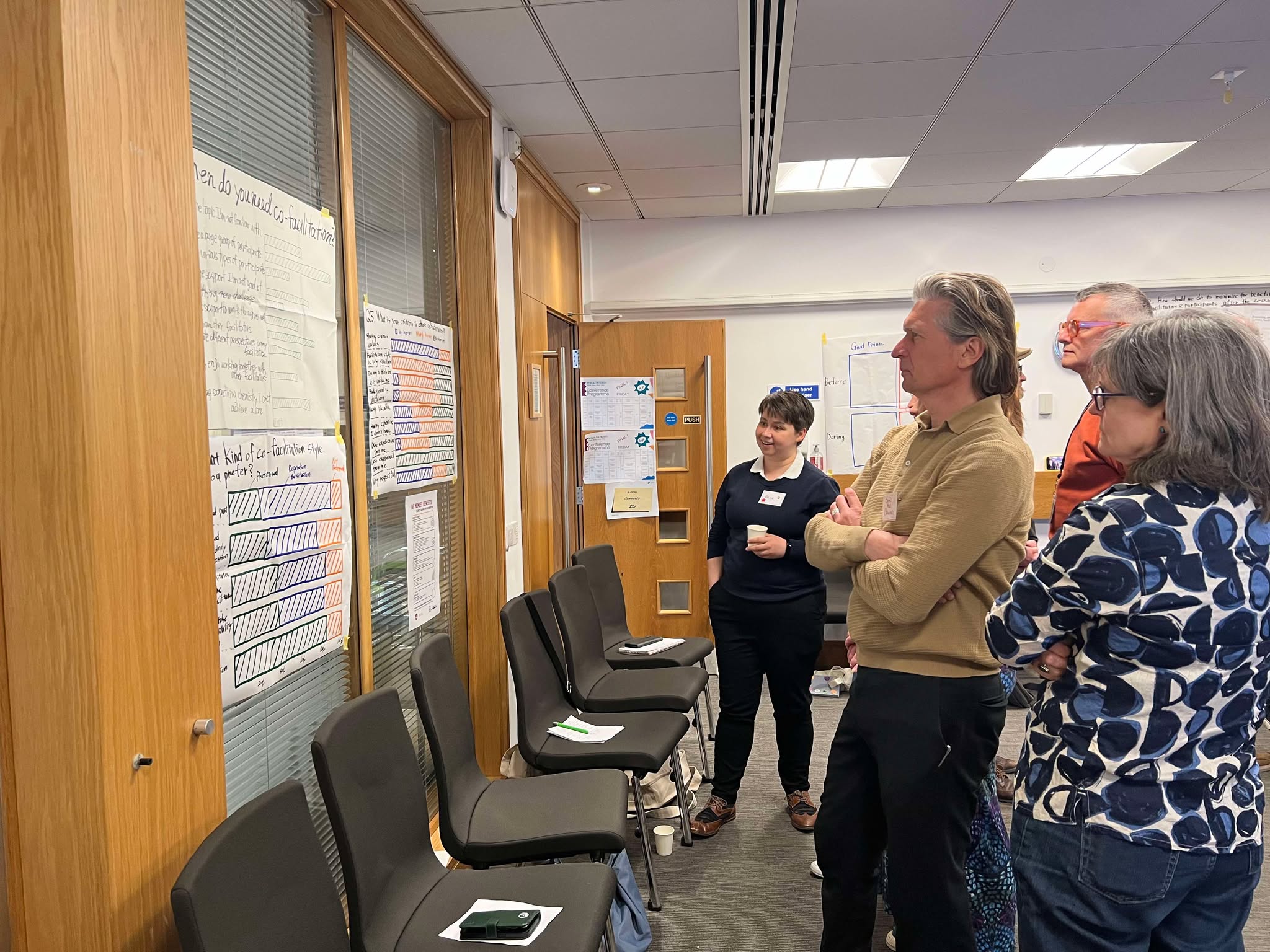
In our workshop, the three of us attempted to co-facilitate the session, but deliberately staged a scenario where our teamwork failed and the facilitators argued in front of the participants.
We then reenacted what had happened before the session in a theatrical manner, allowing participants to witness both the pre-session and in-session dynamics of co-facilitation.
This setup encouraged participants to consider what the three facilitators should have done to succeed. Although we announced in advance that the session would be theatrical, the unexpected developments and continuous laughter created a highly unusual atmosphere for a facilitation session.
A video showing the entire process is available for more details.
The “Theatrical Facilitation” approach, which I often use at overseas conferences, offers several advantages as following
1. Japanese facilitators who are not native English speakers can memorize lines and speak smoothly.
When Japanese facilitators present at overseas sessions, they tend to use filler words like “Well…,” “So…,” or “Ah…,” which can sound less polished. Memorizing lines as a script and speaking in character helps avoid these fillers and allows for confident, natural delivery. Even though memorization is required, being in character makes it easier to speak naturally, and the interactive nature of the performance helps recall lines.
2. Character settings and scripted interactions allow co-facilitators to share roles equally.
There are various styles of co-facilitation. Often, sessions are divided into topics, with each facilitator leading different sections. Sharing topics equally is one way, but I prefer progressing through interactive dialogue, which creates a more engaging impression and fosters “chemistry” between co-facilitators.
3. Projecting the workshop theme onto character settings and telling the story enhances the persuasiveness of the message.
Theatrical format allows for interactive progression. The weight of each role depends on the character. For example, when pairing a well experienced facilitator with a younger facilitator, the well experienced often handles key messaging. I prefer adapting drama style to convey important messages through story, sometimes having unexpected characters serve as storytellers, which increases emotional engagement and persuasiveness.
For example, contrasting “Should do” and “Shouldn’t do” in co-facilitation is more effectively conveyed through a “Good cop, Bad cop” story than through a lecture.
4. Most importantly, it entertains participants and energizes the entire room.
Acting out the lecture parts makes the session lively, and participants’ reactions create further interaction.
In this workshop, we not only showed bad examples of co-facilitation but also demonstrated good examples, asking participants to identify them and output what is necessary for good co-facilitation.
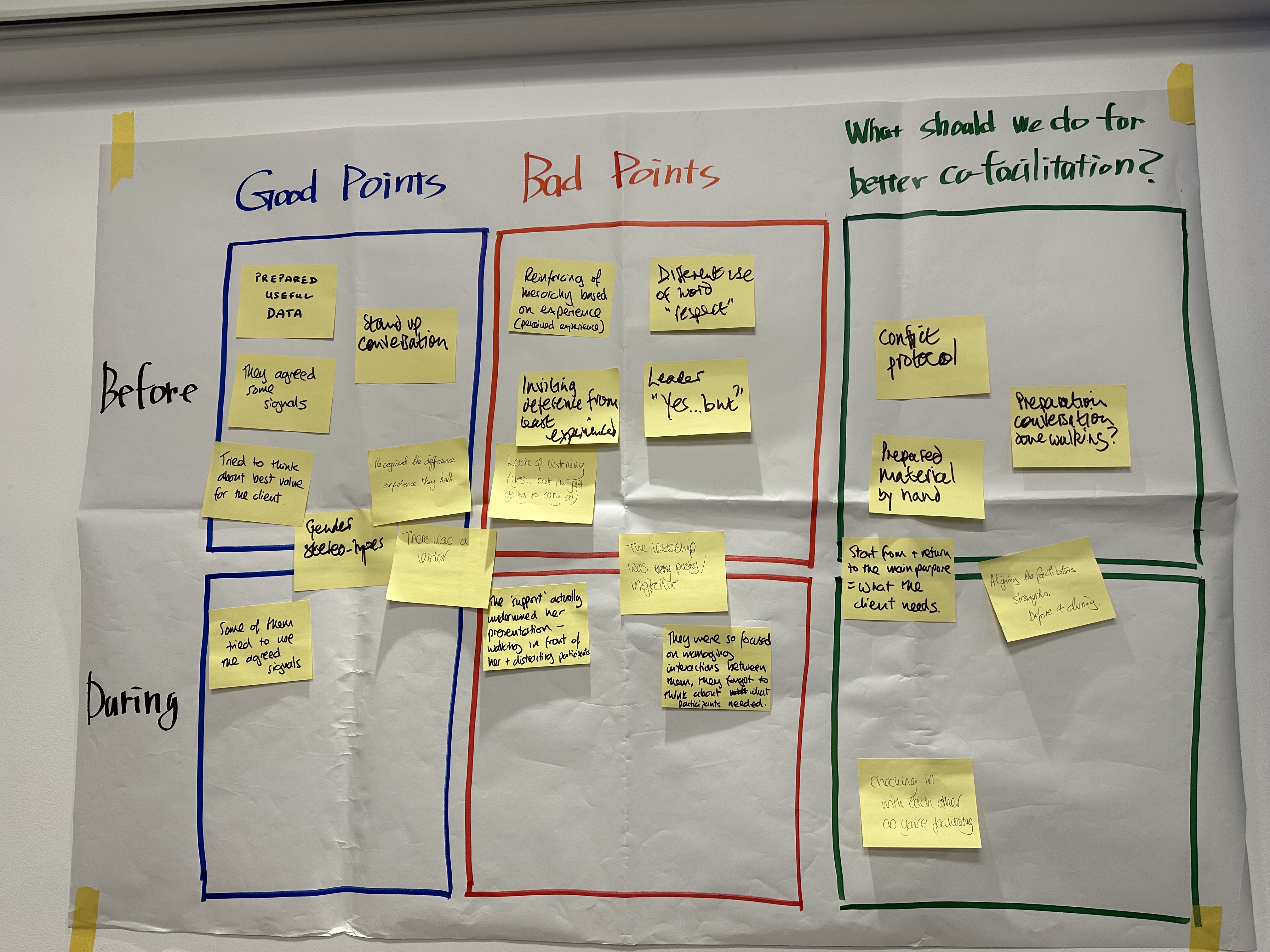
Participants were asked to list good and bad points observed before and during the session, and to consider what facilitators should do before, during, and after the session for better co-facilitation for both facilitators and participants.
These are outputs.
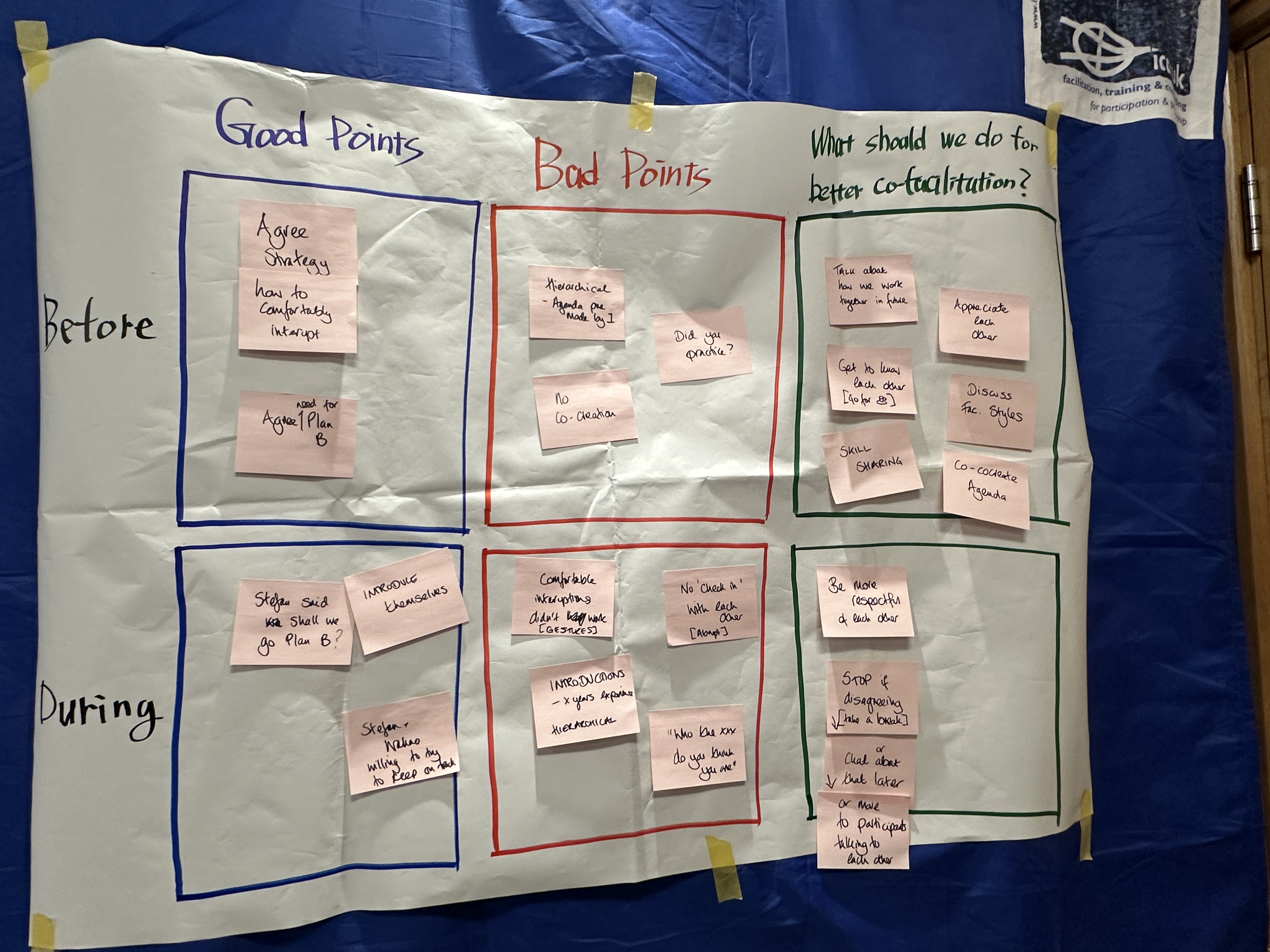
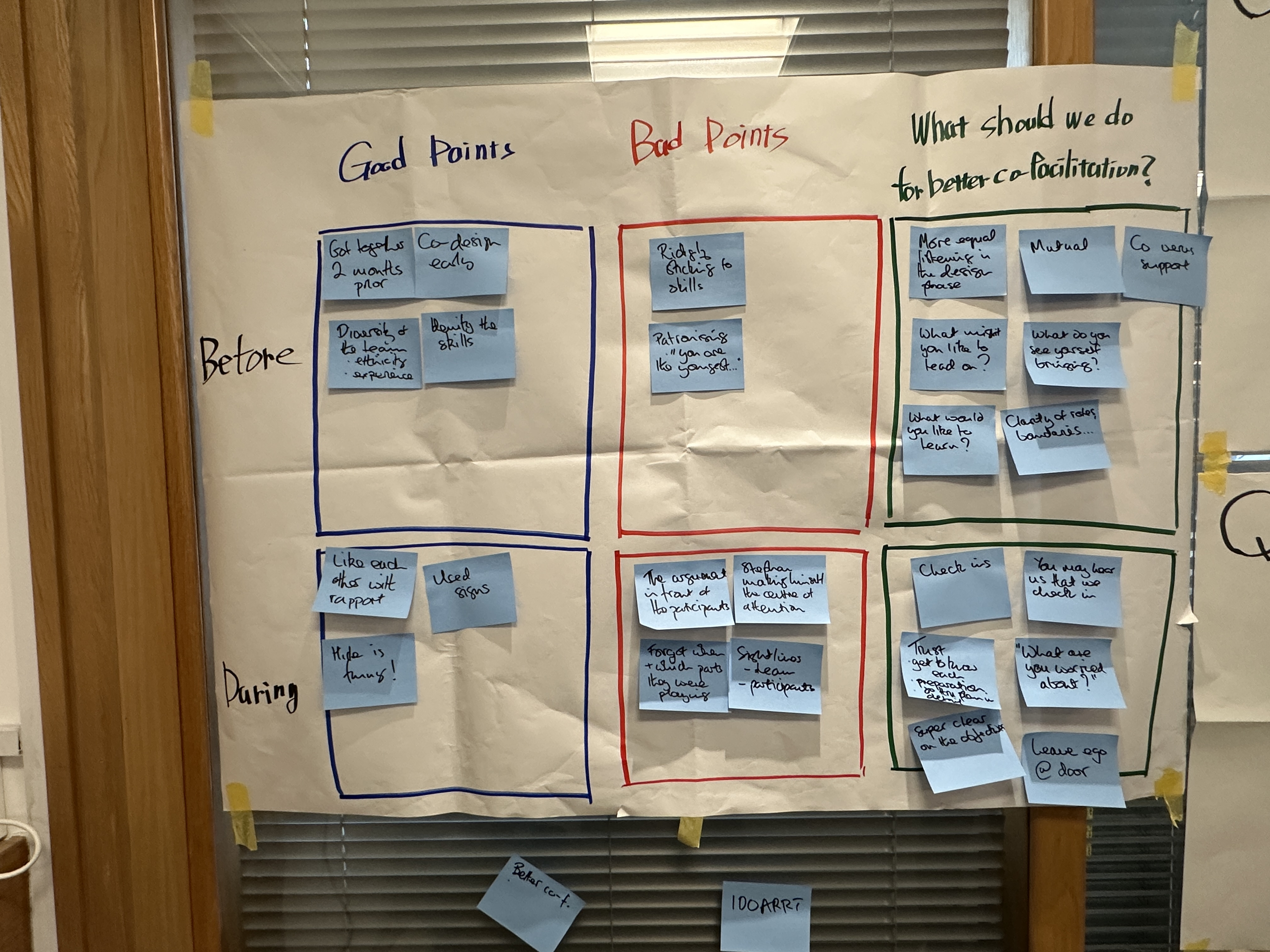
At the end of the workshop, we used ChatGPT to summarize participants’ outputs into a facilitation graphic. By uploading a photo of the flip charts and prompting for a summary, we could create a facilitation graphic like drawn by graphic recorders.
This is too simple structure and may not depict a perfectly accurate summary, but it is very helpful to quickly landscape what we learned.
In recent days, use of AI in facilitation is a topic of growing interest among facilitators worldwide. This could be one good example.

This workshop, from design to rehearsal to execution, was truly a harvest of co-facilitation. Working with multiple facilitators enables styles like Theatrical Facilitation, which would be impossible alone, and provides more significant value from various perspectives.
We ourselves fully experienced “The Art of Co-Facilitation.”
(Report by: Hideyuki Yoshioka, Knowledge Sign Inc.)